
Fine Lines & Wrinkles
Smooth as a baby’s bottom. Not saying we necessarily want to correlate that to our faces, but the idea is the same. Fine lines, fine wrinkles, and crepey skin can disrupt the surface of our skin — let’s fix that.
For everyday skincare essentials, pre- and post-treatment support, procedure enhancers, or even treatment alternatives, we’ve got you covered.
Fine Lines & Wrinkles Overview
Fine lines are shallow creases near the surface of the skin. They’re usually the first lines to appear, most often around the eyes and mouth. They form as collagen and elastin, the proteins that keep skin firm and springy, break down with age, sun exposure and smoking, and as the same facial expressions crease the skin over and over. With time, some deepen into wrinkles. Of note, if you’re thinking a little bigger than just the lines and wrinkles, check out our Facial Skin Laxity page.
Fine Lines & Wrinkles Causes, Symptoms & Solutions
What is the anatomy of the skin and how does it lead to fine lines, wrinkles, and crepey skin?
Let’s get under the skin. There are three main layers of skin with each serving a slightly different purpose.
The Anatomy of Aging Skin
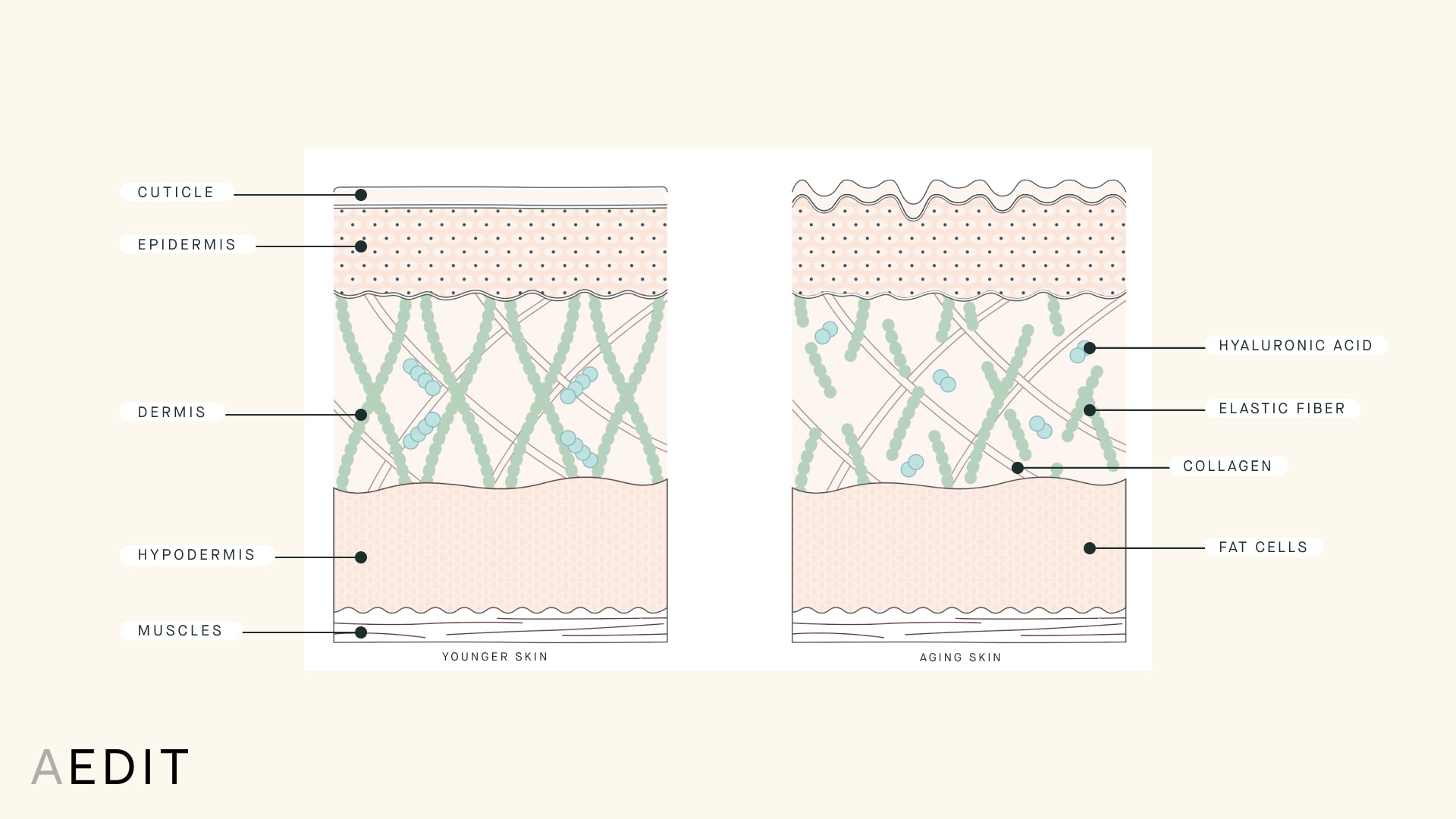
At the top lies the epidermis, which contains your melanocytes or skin pigment producing cells. Next comes the dermis, containing fibroblasts for collagen and elastin production. Collagen and elastin are two critical proteins for skin structure. Collagen provides the latticework on which the body builds its tissues. Elastin gives the skin its elastic, snap back abilities. Finally, the hypodermis contains connective tissue and fat tissue. Skin cells are constantly being lost and replicated-the average person loses hundreds of thousands of skin cells an hour.
- Fine Lines & Wrinkles: Fine lines and wrinkles occur as skin collagen and elastin break down over time from aging, daily wear and tear from pulling on the facial structure by facial muscles, sun exposure, environmental factors, and skin damage. Fine lines appear first, usually around areas of high use like the mouth and eyes. With time these fine lines evolve into deeper creases called wrinkles.
- Crepey Skin: We all love crepes, but it’s doubtful many of us would consider crepey skin a positive. This type of skin appearance is correlated to loss of elastin fiber integrity. Basically, when elastin stops functioning properly the elastic snap back property of our skin is lost, thus the pastry look. Thin, wrinkly skin primarily affects older individuals, however, genetic predispositions, sun exposure/sun damage, dry skin, poor sleep or diet, and significant weight changes can cause crepey skin appearance in people of any age.
What causes the fine lines, wrinkles, and crepey skin to appear?
The takeaway from the above paragraph is collagen and elastin are critical to skin tone, tightness, and appearance. We’re all going to age. And one of the joys of aging is loss of collagen and elastin integrity.
As with anything in life, when the foundation starts to go so too does the overlying structure. Fine lines and wrinkles will happen to everyone as they age. Crepey skin will as well, however, crepey skin is more likely to occur in younger individuals with certain risk factors. Skin damage, sun exposure, weight changes, stress, poor sleep and diet, and certain medications and medical conditions can contribute to the appearance of fine lines, wrinkles, and crepey skin.
What are the most common types of fine lines and wrinkles?
Let’s play a name game now. Who wouldn’t want to specifically study and identify every line, crease, and wrinkle on their face?
- Bunny Lines: Think Nicole Kidman. These are the wrinkles that appear triangularly and horizontally at the corner of each eye and spread down the nose when you scrunch your nose.
- Crow’s Feet: We probably don’t need to review this one, but these are the lines that form on the outside corners of the eyes and spread towards the temples.
- Glabellar Lines (a.k.a. Frown Lines): If you’ve been chronically scowling or concentrate really intensely when you read, you may notice vertical creases between your eyes… just tell people you’re very serious about life.
- Forehead Lines: These are the large horizontal creases running across the forehead between the temples. You may be more prone to these if you spent a lot of time being surprised.
- Lip Lines (a.k.a. Smoker’s Lines or Lipstick Lines): You don’t have to have been a smoker or worn lipstick to develop the vertical lines running across the lips.
- Marionette Lines: The vertical lines that run from the corners of the mouth to the chin. These can cause people to mistakenly search for strings connecting you to a puppeteer.
- Nasolabial Folds (a.k.a. Laugh Lines): These are the parenthetical lines running from the base of the nose to the corners of the mouth. If you don’t want people to think you were happy and enjoyed your life then these need to go.
Who may wish to seek treatment for fine lines, wrinkles, and crepey skin?
Whether we realize it or not, most of us estimate each other's age by observing the appearance of our faces. One of the first places to show signs of aging is the face which is basically a visual history of our time on earth. If you are looking to correct signs of premature, or just normal aging, a treatment to smooth and lessen fine lines, wrinkles, and crepey skin is a good (and more effective) choice than anything you can get over the counter.
Fine lines or wrinkles?
Fine lines are shallow and often show only when your face moves or your skin is dry. Wrinkles are deeper creases that stay when your face is at rest. The same daily routine helps both, but deeper wrinkles usually need in-office treatment to change much.
What daily routine helps with fine lines?
A short routine, done every day, covers most of what over-the-counter care can do for fine lines.
Morning: moisturizer and sunscreen. After a gentle cleanse, apply a moisturizer, then a broad-spectrum sunscreen with SPF 30 or higher on your face, neck and the skin around your eyes. Daily sun protection is the step dermatologists put first for preventing early skin aging. Sunglasses help too, because they cut down on squinting.
Evening: retinol, introduced slowly. Retinol is an over-the-counter form of vitamin A. Retinoids, the family it belongs to, can improve fine lines and skin tone over time. Start with a gentle formula on a few evenings a week (the American Academy of Dermatology suggests every other night to start) and use more only if your skin stays comfortable. Some dryness, flaking or stinging is common at first; follow with moisturizer. Use retinol at night, because retinoids make skin more sensitive to the sun. Our guide to retinol and retinoids explains strengths and how to read a label.
Ask a clinician first if your skin is sensitive, you have a skin condition such as rosacea or eczema, or you’re not sure retinol suits you.
Lines around the eyes. The skin here is thinner and irritates more easily, so many people use a separate eye cream or serum rather than their face products. See our eye cream picks for crow’s feet, dark circles and puffiness.
What to expect. A routine like this can soften the look of fine lines and help slow new ones from forming, but it won’t make existing lines disappear. Results build gradually. If you’d like more change than skincare gives, a clinician can talk through prescription options and the in-office treatments below.
How can someone treat fine lines and wrinkles?
So, now it’s time to figure out how to get rid of those fine lines and wrinkles. You’re in luck. There are a lot of options, and determining which is best for you begins with continuing your self education. Dermal Fillers and injectables, BoNT-A injections, Laser Skin Resurfacing, microdermabrasion, dermabrasion, chemical peels, Facial Fat Transfer, and Microneedling will all improve and smooth skin, although their approaches differ slightly.
- For Bunny Lines: Dermal Fillers, BoNT-A injections (Botox Facial, Botox), cosmetic acupuncture, and topical medications like tretinoin can smooth the skin.
- For Crow’s Feet: Dermal Fillers (Under Eye Filler), BoNT-A injections (Botox Facial, Botox, Periorbital Botox), cosmetic acupuncture, and topical medications like tretinoin will get the job done.
- For Glabellar Lines and Forehead Lines: Dermal Fillers, BoNT-A injections (Botox Facial, Botox), cosmetic acupuncture, and topical medications like tretinoin can smooth the forehead.
- For Lip Lines (Smoker’s Lines; Lipstick Lines): Dermal Fillers (Temporary Lip Fillers, Semi-Permanent Lip Fillers, Permanent Lip Fillers), BoNT-A injections (Botox Facial, Botox), cosmetic acupuncture, and topical medications like tretinoin can soften fine lines over time.
- For Marionette Lines: Dermal Fillers, BoNT-A injections (Botox Facial, Botox), cosmetic acupuncture, and topical medications like tretinoin can prevent people from mistakenly thinking you are a puppet.
- For Nasolabial Folds: Dermal Fillers, BoNT-A injections (Botox Facial, Botox), cosmetic acupuncture, and topical medications like tretinoin can get rid of those pesky grooves.
To better understand the treatment options outlined above, check out our compelte guide to Dermal Filler & Injectable Solutions.
## How can someone treat crepey skin?
Since crepey skin can be a little more multifactorial than fine lines and wrinkles, the available treatments differ slightly.
- Chemical Peels: Superficial Chemical Peels (Glycolic Peel, Salicylic Acid Peel, Jessner’s Peel), Medium Depth Chemical Peel (ViPeel, TCA Peel), and Deep Chemical Peels (Croton Oil Peel and Phenol Peel) will help to encourage natural rejuvenation.
- Dermabrasion and Microdermabrasion: Crystal Microdermabrasion or Diamond Tip Microdermabrasion can exfoliate and enhance skin appearance.
- Laser Skin Resurfacing: Will promote the body’s natural healing. There are ablative lasers like Ablative Non-Fractional Laser Skin Resurfacing, Ablative Fractional Laser Skin Resurfacing, Ablative CO2 Laser, Ablative Erbium Laser, CO2RE, Fraxel Repair, SmartSkin, Pixel CO2, Icon 2940, Deka Dot, Pearl Laser, Profractional Laser Therapy, and Fraxis Duo. There are also non-ablative lasers like Non-Ablative Non-Fractional Laser Skin Resurfacing, Non-Ablative Fractional Laser Skin Resurfacing, Clear + Brilliant, IPL, and Pulsed Dye Laser. Halo™ is a combination Hybrid Fractional Laser. LED light therapy may also be effective.
- Microneedling: involves creating microdamage to stimulate skin restoration. Techniques include Microneedling with PRP, Microneedling with Radiofrequency, Microneedling with PRP and Stem Cells, Infini RF, and Trifecta Therapy
- Plasma Skin Resurfacing: Uses heat and laser resurfacing techniques to stimulate skin rejuvenation.
Learn more by reading our guide to Skin Smoothing Solutions.
Curious what Fine Lines & Wrinkles Solutions are available?
Explore procedure recommendations from AEDIT Experts to address your Fine Lines & Wrinkles concern.


Discover science-backed solutions from AEDIT Medshop
We've taken out the guesswork so you can shop with confidence, knowing you're choosing what's right for you.

Need help finding the best option for you?