
Written By: Erin Storm, PA-C
Published: March 19, 2021
Last updated: June 24, 2025
For everyday skincare essentials, pre- and post-treatment support, procedure enhancers, or even treatment alternatives, we’ve got you covered.

The Skinny
Excess fat, loose skin, excess skin, and abdominal protrusion can cause some significant aesthetic concerns in the abdominal wall area (check out our complete guide to Abdominal Contour Concerns). These issues can be caused by weight gain, weight loss, natural aging leading to loose skin, pregnancy, and weightlifting. Fortunately, a board certified plastic surgeon can utilize a non-surgical or surgical body contouring procedure targeted to the abdominal wall to create your ideal aesthetic.
The Specifics
Who may consider abdominal slimming procedures?
Let’s briefly review the abdominal wall to better understand how things go wrong and how you can fix it. The abdominal wall has two major fascia layers (subcutaneous tissue) called Scarpa’s fascia and Camper’s fascia. The muscles of the abdomen are also wrapped in fascia. The major muscle groups are the rectus abdominis (six pack), internal and external obliques, and the serratus anterior up near the underarms.
The Anatomy of the Abdominal Wall
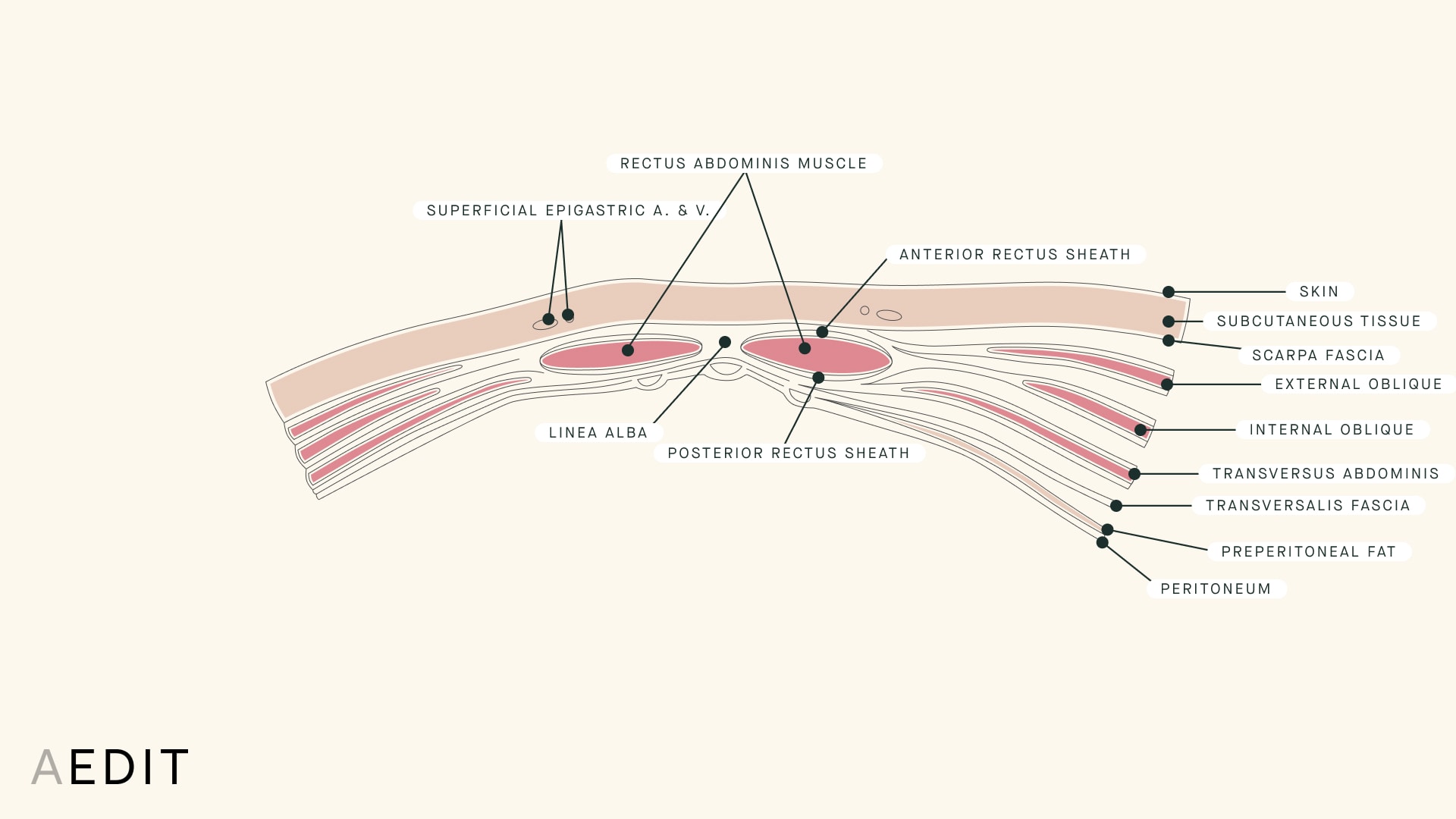
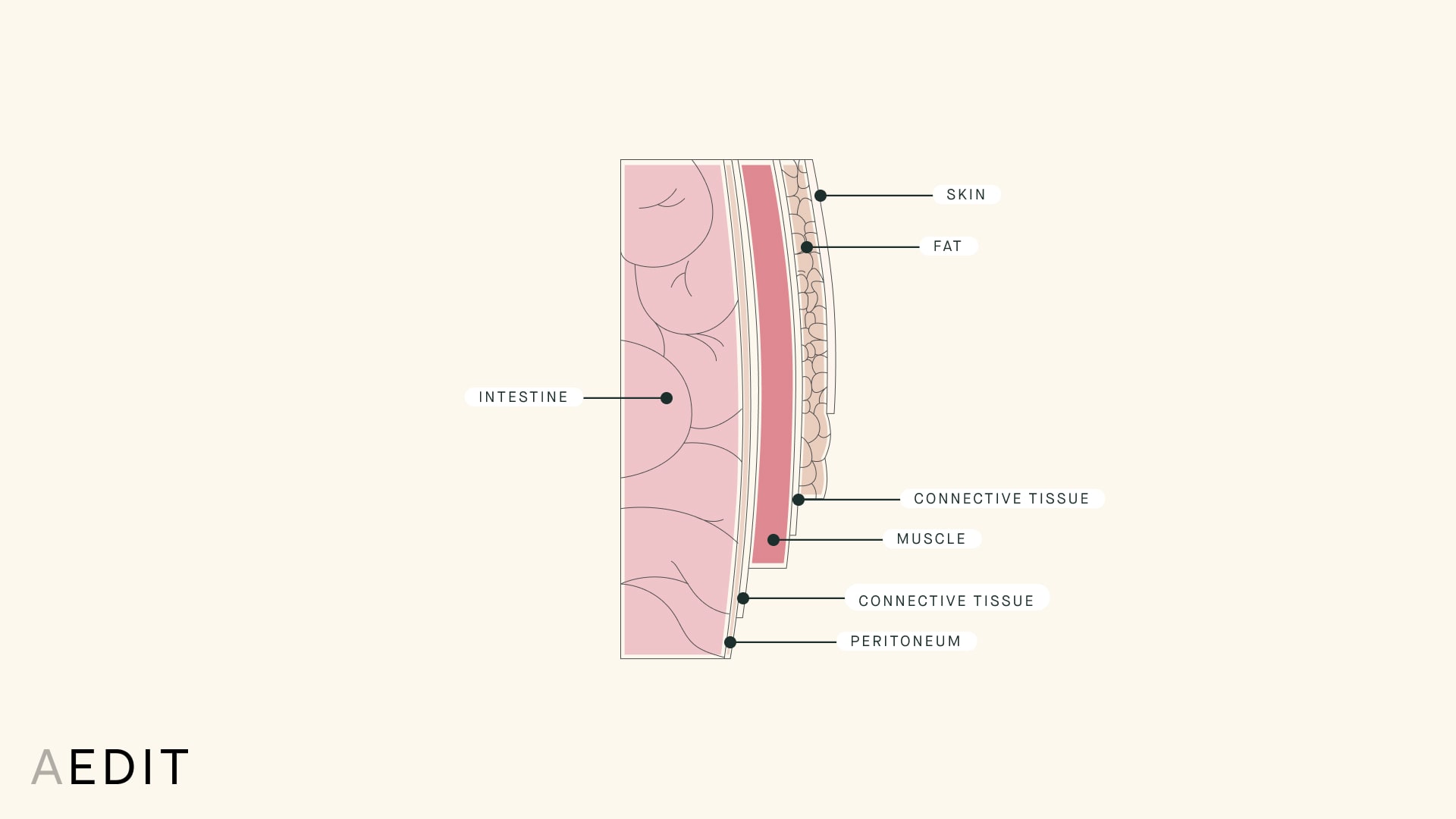
Men are more prone to storing fat in the abdominal area, while women are more likely to store excess fat in the thighs. As we age, the distribution of fat deposits in the body changes, and fat will naturally accumulate in the midsection. Skin will also become sagging and droopy. Pregnant women, and obese older males especially are susceptible to diastisis recti.
- Belly Fat: Correlated to high levels of body weight and body fat. When it comes to muscle use it or lose it, and when it comes to calories use it or store it, so eat right and exercise.
- Diastasis Recti: Seperation of the right and left sides of the rectus abdominis at the connective tissue.
- Skin Laxity: Skin laxity can occur naturally with the joys of aging as collagen and elastin break down, or it can occur in individuals who have experienced extreme weight loss.
What can you expect from abdominal slimming procedures?
Abdominal slimming procedures can alter, rejuvenate, and enhance the soft tissues of the abdominal wall. There are both surgical and nonsurgical options depending on your underlying concern.
- Tummy Tuck: Get rid of the excess and tuck the rest into an aesthetically pleasing contour. Win, win!
- Liposuction: A 'fat vacuum' (so to speak) that permanently removes fat cells.
- Diastasis Recti Repair: A procedure to sew your abdomen back together after pregnancy or weight loss.
- Non-Surgical Fat Reduction: Freeze, heat, inject! These non-surgical techniques can still slim without any sharp objects.
Both surgical and non-surgical procedures to the abdominal wall will be effective and produce significant results. It is important to keep in mind, all of these procedures will be subject to changes in weight, aging, and future pregnancies. Additionally, many of the surgical procedures require patients to wear a compression garment during the recovery period.
When should you consider an abdominal slimming procedure?
If you’re looking to repair your separating abdominal wall in the case of diastasis recti, the ideal time to fix it is probably now. If, on the other hand, your concern is cosmetic, then the best time to pursue a procedure is when you are in generally good health, have realistic expectations, and can commit to the recovery period. Also, consider if you're at a stable weight, and, for women, the possibility of future pregnancies.
Why should you consider an abdominal slimming procedure?
Why repair, enhance, refine, and define your abdominal wall? Here are a few reasons: to repair your damaged abdominal wall, to lose the fat without the effort, or to create your ideal abdominal contour.
Surgical Procedures for Abdominal Slimming
Depending on the cause of your abdominal concerns, surgeries like tummy tuck and liposuction (or some combination of the two) can provide a slim, taught mid-section.
Tummy Tuck
A classic procedure to tone and tighten the abdomen.
- Abdominoplasty
- Overview: Excision of skin and fat to tighten the abdominal area.
- Cost: $3,000 - $15,000
- Recovery & Results: Swelling and tenderness for three weeks. Results finalize by six months.
- Mini Tummy Tuck
- Overview: A tummy tuck surgery technique under general anesthesia with less scarring in the lower abdomen.
- Cost: $4,000 - $5,500
- Recovery & Results: Swelling, tenderness, and tightness for three weeks. Final results within three months.
- Panniculectomy
- Overview: Excision of skin and fat of the lower abdomen due to medical necessity.
- Cost: $8,000 - $15,000
- Recovery & Results: Swelling and tenderness for three weeks. Results finalize by six months.
Diastasis Recti Repair
How to correct a divergence of your abdominal wall due to pregnancy, poor weightlifting techniques, or obesity.
- Diastasis Recti Repair
- Overview: The abdominal musculature will be sutured back together, and the skin can be corrected if needed.
- Cost: $5,000 - $19,000
- Recovery & Results: Limit activities for about one month. Swelling can last for six weeks. The results are permanent.
The Anatomy of Diastasis Recti

Liposuction for Abdominal Slimming
There are an array of liposuction techniques that can permanently remove fat cells from the mid-section.
- Tumescent Liposuction
- Overview: Lipo with a tumescent solution (lidocaine, epinephrine, and saline) that numbs and constricts the area leading to less tenderness and bleeding.
- Cost: $2,000 - $11,000
- Recovery & Results: Swelling and bruising for two weeks. The results are temporary.
- Power Assisted Liposuction
- Overview: A vibrating tipped instrument loosens fat prior to removal.
- Cost: $2,000 - $8,000
- Recovery & Results: Swelling and bruising for a few weeks. Results are permanent.
- Ultrasound Assisted Liposuction
- Overview: Ultrasound waves melt fat prior to removal. The waves also improve skin elasticity.
- Cost: $1,500 - $10,000
- Recovery & Results: Swelling and discomfort for one week. Results evolve over four months.
- Water Jet Assisted Liposuction
- Overview: A variation of tumescent assisted lipo that instead uses water to assist fat removal.
- Cost: $4,500 - $10,000
- Recovery & Results: Bruising and swelling for up to four weeks. The results will evolve over one year.
- Laser Assisted Liposuction
- Overview: Laser energy emulsifiers fat to simplify removal.
- Cost: $2,500 - $5,500
- Recovery & Results: Swelling improves over two weeks. The results are temporary.
- Radiofrequency Assisted Liposuction
- Overview: Radio waves simultaneously remove fat and tighten skin.
- Cost: $2,600 - $8,500
- Recovery & Results: Swelling resolves by six weeks. The results are temporary.
- Liposculpture
- Overview: A combination of fat removal with muscular toning.
- Cost: $1,400 - $9,500
- Recovery & Results: Swelling, bruising, and tenderness for four weeks. The results finalize over six to 12 months.
- SlimLipo
- Overview: Aka selective laser induced melting. Tumescent liposuction with lasers.
- Cost: $1,500 - $6,000
- Recovery & Results: Swelling and bruising for seven days. Results evolve over six months.
- SmartLipo
- Overview: Another variation of laser assisted liposuction.
- Cost: $1,500 - $6,000
- Recovery & Results: Swelling for two to three weeks. Results will improve over six months.
The Anatomy of Belly Fat
In the Los Angeles area?
Book yourself a Abdominal Slimming Solutions treatment at AEDIT Cosmetic Wellness.
Non-Surgical Fat Reduction for Abdominal Slimming
If surgery is not for you, maybe it's time to employ cold, heat, or light to blast away unwanted fat.
- CoolSculpting®
- Overview: Brrrr. Fat cells get an icy blast.
- Cost: $2,000 - $4,000
- Recovery & Results: Mild swelling and discomfort. Up to three treatments will be needed for best results.
- Lipodissolve
- Overview: An injectable fat dissolving solution.
- Cost: $150 - $6,000
- Recovery & Results: Bruising and swelling for 10 days. Multiple treatments will be required.
- SculpSure
- Overview: Lasers and heat to melt fat.
- Cost: $1,400 - $1,500
- Recovery & Results: Minimal associated side effects. Results are permanent, but will require multiple treatments.
- BodyTite™
- Overview: RFAL energy to emulsify fat and improve skin laxity.
- Cost: $5,500 - $14,500
- Recovery & Results: Swelling, bruising, and tenderness resolve within a few days. The results last a few years.
- truSculpt®
- Overview: RFAL energy to reduce fat deposits and promote muscle enhancement.
- Cost: $1,000 - $2,500
- Recovery & Results: Swelling and tenderness resolve within a one day. The results will evolve over 12 weeks.
- Emsculpt
- Overview: High-intensity electromagnetic waves stimulate muscle contractions for muscle building.
- Cost: $1,000 - $4,000
- Recovery & Results: Swelling and redness resolve within a few hours. The results will evolve over at least four treatment sessions.
Discover science-backed solutions from AEDIT Medshop
We’ve taken out the guesswork so you can shop with confidence, knowing you’re choosing what’s right for you.

Not sure what’s the right treatment for you?
Schedule an appointment to get your customized treatment plan.
To learn more about our content creation practices, visit our Editorial Process page.


