- the aedition
- Wellness
- The Intimate Wellness Conversation Is Changing: What Treatments Can and Cannot Do
The Intimate Wellness Conversation Is Changing: What Treatments Can and Cannot Do

“Intimate wellness” has become a catch-all for everything from vaginal dryness and painful sex to urinary leakage, erectile dysfunction, and changes in sexual function—but it’s a marketing term, not a diagnosis. Genital comfort, urinary function, sexual desire, arousal, orgasm, erections, pain, and hormonal symptoms can have very different causes and different effects on individuals. Treatments such as MonaLisa Touch use fractional CO2 laser energy for certain vulvovaginal concerns, while the O-Shot and P-Shot are names for non-standardized platelet-rich plasma injections. Evidence supporting these procedures remains limited, and nothing is a guaranteed fix, which is important for patients to understand.
While some treatments, which should be performed after identifying symptoms, possible causes, and a comprehensive assessment, may provide relief, be it short- or long-term, persistent or concerning symptoms warrant evaluation by a specialist to identify hormonal, vascular, neurologic, medication-related, infectious, dermatologic, pelvic-floor, or psychosocial causes before considering a procedure.
What Are Intimate Wellness Treatments?
“Intimate wellness” is a catch-all term to describe treatments and services that focus on improving the functionality and health of intimate areas, as well as hormonal balance, pelvic floor strength, and overall sexual wellness. But it isn’t a medical diagnosis. Dr. William Kennedy, AEDIT Founder and board-certified facial plastic and reconstructive surgeon, explains, “‘Intimate wellness’ can be a useful way to start conversations about concerns patients may otherwise feel uncomfortable bringing up. Symptoms like discomfort, dryness, changes in sexual function, or urinary concerns can have many different causes, which is why the conversation should always lead to a proper medical evaluation rather than a one-size-fits-all treatment.”
The consumer and commercial buzzword also encompasses energy-based devices, injectable treatments, hormone evaluation, prescription medications, counseling, and care from medical specialists. These approaches aren’t interchangeable, and a treatment marketed for “intimate wellness” isn’t necessarily a one-size-fits-all solution.
Intimate concerns differ from person to person. Vulvar or vaginal dryness, irritation, and pain differ from urinary urgency or leakage, just as changes in sexual desire, arousal, or orgasm require a separate evaluation and treatment from erectile or ejaculatory difficulties, penile pain, or gender-affirming care or recovery after medical treatments.
Determining the proper plan and treatment options should always begin with identifying the symptom. A clinician should assess when it began, how long it has persisted, severity, the patient’s medical and surgical history, medications, hormonal status, and, when relevant, relationship or psychosocial factors. A thorough assessment can determine whether conventional medical treatment, pelvic-floor therapy, energy- or platelet-based treatment is best.
What is MonaLisa Touch?
MonaLisa Touch is an energy-based treatment that uses fractional carbon dioxide (CO2) with unique gynecologic applicators to deliver controlled energy to vaginal and vulvar tissue. The treatment creates microscopic areas of thermal injury that trigger a tissue-healing response and create new collagen for thicker tissue.
MonaLisa Touch helps alleviate common symptoms associated with genitourinary syndrome of menopause (GSM), including vaginal dryness, burning, painful sex, and urinary incontinence and frequency. Early observational studies reported improvements in several of these symptoms, helping fuel interest in vaginal laser treatments. However, recent research says otherwise. Recent systematic reviews have found that CO2 lasers may offer short-term improvements in certain symptoms, but overall evidence is scant. Long-term effectiveness and durability also remain unclear.
There’s also an important regulatory distinction. The MonaLisa Touch laser system has FDA clearance for incision, excision, ablation, vaporization, and coagulation of soft tissue, particularly in gynecology. But FDA clearance and FDA approval are the same. The clearance does not cover every claim associated with vaginal rejuvenation, menopause, sexual function, or urinary symptoms. The FDA has previously challenged marketing claims that extended beyond the device’s cleared indications.
Potential risks include pain, burning, scarring, painful intercourse, and persistent discomfort, while long-term safety data remain limited.
What is the O-Shot?
The O-Shot (“Orgasm Shot”) is a commonly performed procedures that relies on platelet-rich plasma (PRP) derived from a patient’s own blood that is then injected into the clitoris, vaginal wall, and/or periurethral tissues. Like many regenerative treatments, no universal standard protocol currently exists for the O-Shot. That means every provider can create their own ‘cocktail’ regarding PRP preparation, concentration, injection sites, dosage, and treatment schedules.
PRP contains concentrated platelets and growth factors, and injecting it into genital tissues is thought to encourage blood-vessel formation, collagen production, tissue repair, and other regenerative processes. But a biologically plausible mechanism isn’t the same as demonstrating meaningful benefits for patients.
Research is promising but still evolving. A 2026 randomized controlled trial found that women receiving vaginal PRP were more likely than those receiving saline injections to report overall improvement in sexual function at six months. However, improvements in individual measures of desire, arousal, lubrication, and orgasm were not statistically significantly different between groups.
Earlier research has also highlighted small study populations, inconsistent protocols, methodological limitations, and an overall low level of evidence. PRP injections shouldn’t come with guarantees of stronger orgasms, increased libido or sensation, improved vaginal laxity or pain, or restored continence. These symptoms can have different underlying causes, making an appropriate medical evaluation important before pursuing treatment.
What is the P-Shot?
The P-Shot, short for Priapus Shot, is a treatment that injects PRP into the penis. Like the O-shot, there is no single standardized protocol including the way PRP is prepared and concentrated, where it’s injected, the amount used, and the number of treatments, all of which can vary.
The theory is that platelets release growth factors that may support blood-vessel formation, nerve repair, tissue healing, and smooth-muscle regeneration. This cascade of regenerative events may potentially improve erectile function. But proposed regenerative activity shouldn’t be confused with proven clinical results.
Penile PRP has been studied primarily as an experimental treatment for erectile dysfunction (ED), and additional research suggests it may have a potential role in treating Peyronie disease. While some studies have reported improvements in erectile functionality, the data is limited and conflicting results exist. Similarly, evidence for Peyronie disease remains preliminary and inconclusive.
Bottom line: The P-Shot should not be marketed as a proven treatment for ED or Peyronie disease, nor should patients be promised permanent penile enlargement, stronger erections, increased sexual performance, or a “cure.” Those claims aren’t supported by the current evidence.
Popular Treatments at a Glance
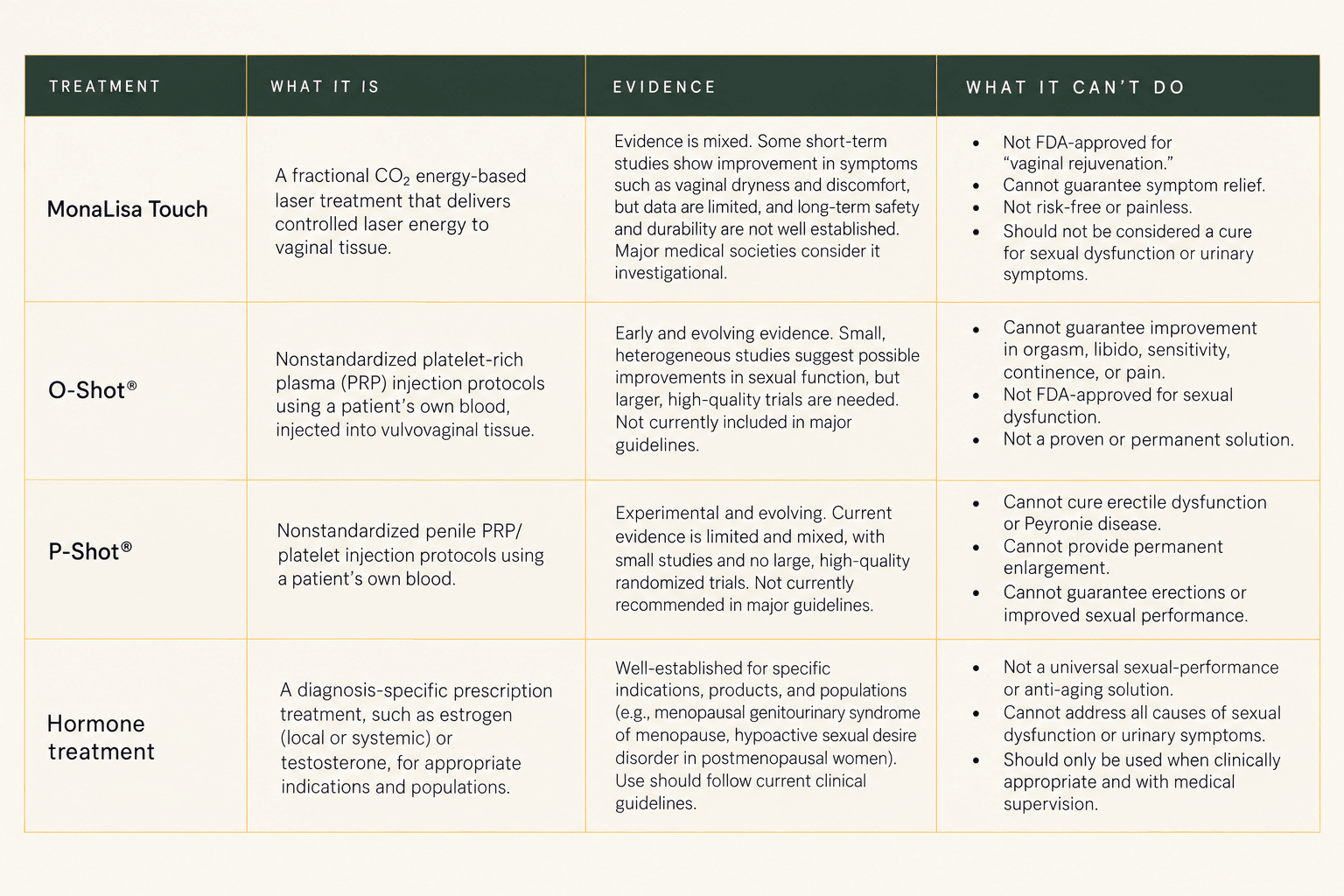
Where do hormones and other medical treatments fit?
Hormones play an important role in sexual and genitourinary health, but they’re only one piece of the puzzle. Common symptoms such as vaginal dryness, painful sex, decreased libido, erectile dysfunction, urinary changes, or changes in sensation may be hormonally related, they can also be caused by vascular and neurologic conditions and issues, certain medications, pelvic floor changes, or dermatologic, infectious, or psychological factors. For some patients, a combination of factors leads to symptoms.
Since hormones alone aren’t reason to blame for every sexual and genitourinary health symptom or issue, it’s also the reason why hormone therapy shouldn’t be viewed as a catch-all “sexual wellness” treatment. Instead, hormone therapy falls within diagnosis-specific medical care. For example, declining estrogen associated with menopause can contribute to genitourinary syndrome of menopause (GSM). But hormones won’t address every cause of sexual dysfunction, and therefore, an effective treatment protocol should be recommended following a thorough medical evaluation instead of adding hormone therapy to a wellness protocol. The goal is to identify what is driving the symptom first, then choose treatment accordingly.
Who should be evaluated by a specialist first?
Certain symptoms warrant a medical evaluation by a specialist first, including unexplained vaginal or penile bleeding, new sores, lumps, or other lesions, persistent or severe pelvic or genital pain, signs of infection, significant or sudden urinary changes, new penile curvature or a palpable plaque, and sudden changes in erectile function.
Depending on the symptom and its specifics, a gynecologist, urogynecologist, urologist, pelvic-floor specialist, dermatologist, endocrinologist, or sexual-medicine specialist may need to perform the evaluation. Since these symptoms can have several different causes and triggers, including hormonal changes, infections, pelvic-floor dysfunction, medication effects, dermatologic conditions, vascular problems, or other underlying medical issues, a proper evaluation by a specialist is of the utmost importance. “Before discussing a procedure, a credible intimate-wellness consultation should establish what symptoms the patient is actually experiencing, how long they’ve been present, and whether there may be an underlying medical, hormonal, pelvic floor, medication-related, or psychological cause. The goal is to understand the problem before deciding whether a procedure belongs in the solution,” says Dr. Kennedy.
Most importantly, an intimate-wellness procedure shouldn’t be used as a shortcut or substitute for a proper diagnosis. Some treatments, such as lasers, PRP injections, and other office-based procedures, may play an essential role in ideal candidates. Still, they should never be a substitute for a proper diagnostic workup, particularly when symptoms are new, persistent, severe, or concerning.
What should patients ask before booking?
Before you book an intimate-wellness treatment, it’s important to fully understand exactly what the treatment entails, what it can realistically accomplish, the pros and cons, and what to expect. According to Dr. Kennedy, “The most important question to ask is: ‘What evidence shows this treatment can improve the specific problem I’m trying to address?’ Patients should understand what the treatment is designed to do, how strong the evidence is, and what a realistic outcome looks like before they spend money on it.”
Start by asking your specialist or provide these questions:
- What symptoms will be treated?
- Has a specific diagnosis been made?
- What specific evidence supports the device, injection, medication, or protocol being recommended?
- Are there any risks or side effects with this treatment?
- Do reasonable alternative solutions exist? And what will happen to my symptoms if I don’t move forward with this treatment?
- How much will the treatment cost?
- How many sessions are recommended to alleviate symptoms?
- Are maintenance treatments necessary? If so, how many?
- What are realistic results?
It’s also important to know whether the treatment is considered established medical care, an off-label use, or experimental. Any reputable provider or specialist should be comfortable discussing a treatment’s limitations and offering a referral when another type of care may be more appropriate.
Discover science-backed solutions from AEDIT Medshop
We’ve taken out the guesswork so you can shop with confidence, knowing you’re choosing what’s right for you.