Eating Your Skincare: Can What You Eat Actually Improve Your Skin?

“Eating your skincare” has become the latest obsession on social media, with creators claiming that certain foods, supplements, and daily rituals are the secret to clearer, brighter, younger-looking skin. But can you really eat your way to a better complexion?
While nutrition plays an important role in collagen production, skin-barrier function, and overall skin health, the idea that a particular food can erase wrinkles, boost collagen, or replace your skincare routine is where things get complicated. So, how much of the “eating your skincare” trend is actually backed by science? We're breaking down what your diet can—and can't—do for your skin.
What Does “Eating Your Skincare” Actually Mean?
First, there was the 10-step skincare routine. Then came skin cycling, barrier repair, and the obsession with achieving glass skin. Now, the beauty conversation is moving from the bathroom cabinet to the kitchen. The concept of “eating your skincare” is relatively simple: Instead of relying exclusively on topical products and aesthetic treatments, people are looking to food as another way to support their skin.
And the internet has plenty of suggestions. Carrot salads are being promoted as edible retinol. Bone broth has become a supposed collagen-boosting beauty essential. Sardines are getting attention for their omega-3 content. Matcha is celebrated for its antioxidants, while collagen powders are finding their way into everything from morning coffee to smoothies. Some creators even share dramatic before-and-after photos, attributing their skin transformations to a single dietary change. It's easy to understand the appeal. Who wouldn't want healthier, smoother, more radiant skin simply by changing what they eat?
The interesting part is that the underlying idea isn't entirely wrong. Skin is a living organ that depends on adequate nutrition to function properly. The body needs protein, vitamins, minerals, essential fats, and fluids to maintain healthy tissue, support normal repair processes, and produce collagen.
But there's an important distinction between eating nutrients your skin needs to function and eating more of those nutrients to achieve a visible cosmetic improvement. Just because a food contains something beneficial for skin health doesn't mean consuming more of it will automatically make your skin look younger, firmer, or clearer. According to AEDIT Founder and board-certified facial plastic and reconstructive surgeon Dr. William Kennedy, “Nutrition is foundational to healthy skin, but there’s a difference between giving your body the nutrients it needs to function and expecting a particular food to visibly transform your complexion. What you eat can support collagen production, skin repair, and overall skin health, but it won’t necessarily reverse wrinkles, restore lost volume, or correct years of sun damage. The best results come from a comprehensive approach that combines good nutrition, consistent skincare, sun protection, and appropriately selected aesthetic treatments.”
Which Nutrients Are Actually Important for Healthy Skin?
When it comes to eating for healthier skin, the basics are far less glamorous than social media might suggest. Your skin requires a consistent supply of nutrients to maintain its structure, support its protective barrier, and repair everyday damage. That means getting enough protein, healthy fats, vitamins, and minerals—not necessarily stocking your pantry with the latest viral superfood.
Here's what the most relevant nutrients actually do.
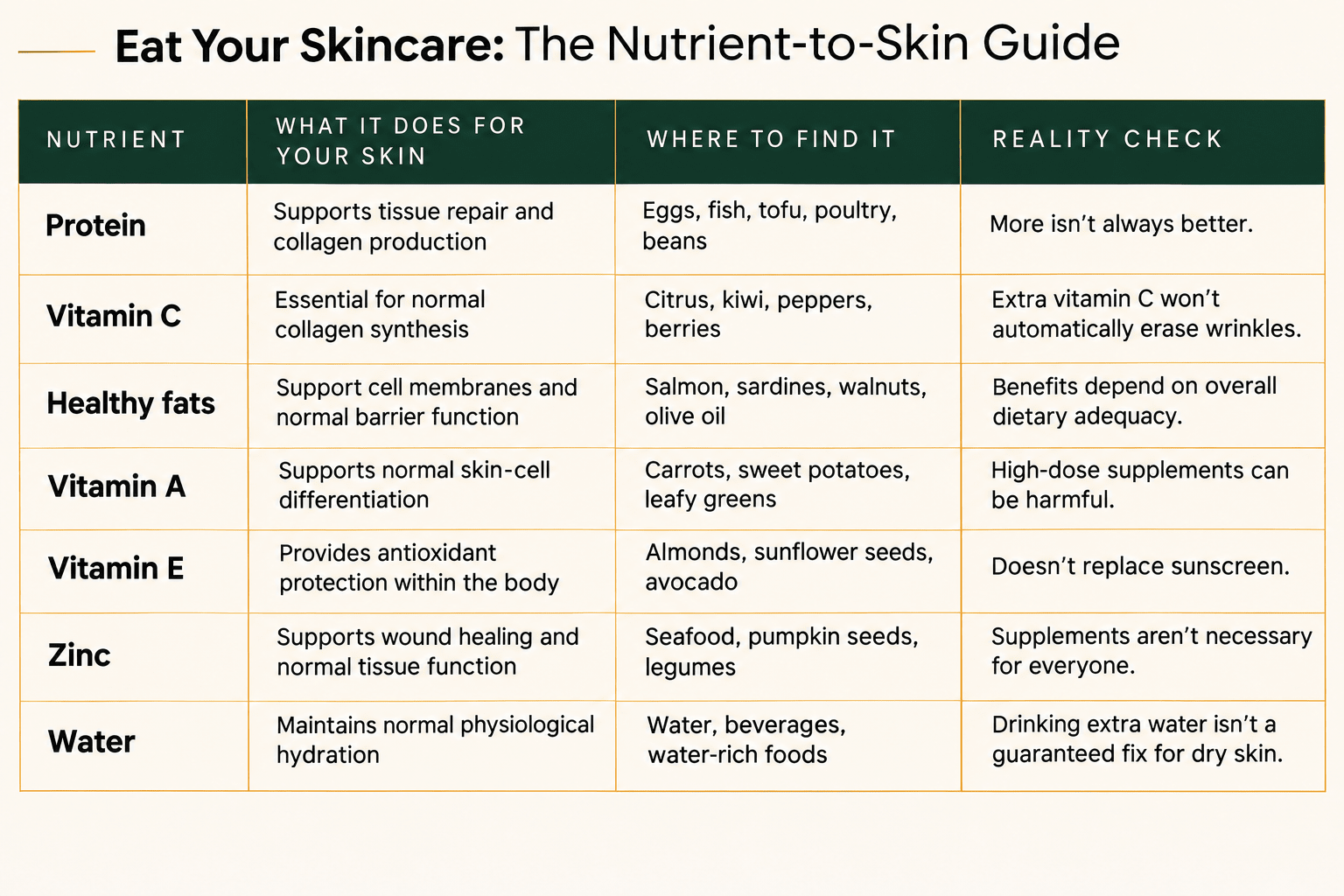
The takeaway? There isn't one universally superior food for your skin. A varied, balanced diet generally offers a more reliable foundation than focusing on individual ingredients. And while correcting a nutritional deficiency can improve skin health, consuming additional nutrients when you're already getting enough doesn't necessarily translate into a visible improvement.
Can Eating More Protein or Collagen-Rich Foods Make Your Skin Firmer?
Protein is essential for maintaining healthy skin, but eating more of it won't necessarily give you firmer skin or fewer wrinkles. Collagen, the structural protein responsible for much of the skin's strength and support, is made from amino acids. Your body obtains those amino acids by breaking down dietary protein from foods like fish, eggs, chicken, beans, and tofu. This is where the popularity of bone broth, collagen-rich foods, and protein-heavy beauty diets comes from. The logic sounds convincing: If collagen keeps skin firm, eating collagen should make your skin firmer, right? Not exactly. When you consume collagen, your digestive system breaks it down into smaller peptides and amino acids. Those components can be used throughout the body, but they aren't automatically delivered to your face to rebuild lost collagen. Eating enough protein is important for normal skin maintenance. However, that doesn't mean eating excessive amounts will reverse age-related collagen loss.
What about collagen supplements?
Collagen powders and drinks deserve a closer look because the research is more complicated than the marketing suggests. Some clinical trials have reported improvements in skin hydration and elasticity with oral collagen supplementation. However, the quality and consistency of that evidence remain important limitations. A 2025 systematic review and meta-analysis published in The American Journal of Medicine examined 23 randomized controlled trials involving 1,474 participants. Although the combined results suggested benefits, the researchers found that studies without pharmaceutical-industry funding and higher-quality studies did not demonstrate significant improvements in the evaluated skin-aging outcomes.
A more recent systematic review of oral collagen peptides reported potential benefits for hydration, barrier function, and elasticity, but did not find robust evidence for wrinkle reduction after more rigorous statistical testing. In other words, the research isn't entirely dismissive of collagen supplements, but it's far from a guarantee that adding a scoop to your coffee will noticeably reverse skin aging. “Collagen is essential for maintaining skin structure and firmness, but eating more collagen doesn’t mean your body will automatically produce more of it in your skin. When we consume protein or collagen supplements, the body breaks them down into smaller components that are used wherever they’re needed. Adequate protein intake supports normal collagen production and tissue repair, but it’s important to have realistic expectations. You can’t simply eat your way out of age-related collagen loss or skin laxity. That’s where a more targeted approach to skin rejuvenation may be beneficial,” says Dr. Kennedy.
Can Changing Your Diet Actually Help Clear Acne?
Of all the claims surrounding food and skin, the relationship between diet and acne is one of the more interesting—and better-studied. If you've seen someone online claim their acne disappeared after giving up sugar or dairy, there may be a scientific explanation for some of those experiences. But that doesn't mean the same dietary change will work for everyone. Research suggests that high-glycemic diets, which include foods that cause relatively rapid increases in blood sugar, may contribute to acne in some individuals. According to the American Academy of Dermatology (AAD), several small studies have found that people following lower-glycemic diets experienced fewer breakouts. One proposed explanation involves insulin signaling, inflammation, and sebum production, all of which can influence acne development. However, the research isn't unanimous. Some studies have not found a significant relationship, and the AAD's clinical guidelines describe the evidence for low-glycemic diets as conflicting. That means reducing high-glycemic foods might be helpful for certain people, but it's not a universal acne treatment.
Dairy is another frequent target of online skincare advice. Some observational studies have identified an association between cow's milk consumption and acne, particularly with skim milk. But an association doesn't prove that milk causes breakouts, and the research does not support telling everyone with acne to eliminate dairy. The AAD also notes that evidence linking yogurt or cheese to acne is not the same as the evidence involving milk.
Instead of immediately cutting out entire food groups, a more practical approach is to pay attention to patterns, discuss persistent concerns with a qualified clinician, and avoid restrictive diets without a clear medical reason. It's also important to remember that acne is influenced by multiple factors, including hormones, genetics, inflammation, and sebum production. Diet may be part of the picture, but it's rarely the entire picture. And while eating well supports overall health, no particular food has been proven to cure conditions such as rosacea or eczema.
Does Drinking More Water Really Give You Glowing Skin?
We've all heard it: Drink more water and your skin will thank you. Hydration is essential for normal bodily function, and inadequate fluid intake can affect overall health. But the relationship between drinking water and visibly hydrated skin is not as straightforward as it sounds.
Your skin's moisture levels are influenced by more than how much water you drink. The outermost layer of skin, known as the stratum corneum, helps regulate water retention. When the skin barrier is compromised, moisture can escape more easily, contributing to dryness, flaking, irritation, and tightness. This is why someone can drink plenty of water and still struggle with dry skin. Environmental conditions, harsh cleansers, over-exfoliation, certain skin conditions, and inadequate moisturizing can all affect the skin barrier.
If you're dehydrated, restoring adequate hydration is important. But if you're already consuming enough fluids, drinking significantly more water may not produce the radiant complexion promised by your favorite wellness influencer. For persistent dryness, a gentle skincare routine and appropriate moisturizers may be more directly useful than another oversized water bottle.
Dr. Kennedy explains, “When someone says their skin looks dull or dehydrated, the first thing we look at is whether they're actually lacking hydration or if their skin barrier isn't functioning properly. You can drink plenty of water and still experience dryness, irritation, and a lackluster complexion. In many cases, the solution isn't more water—it's addressing what's happening at the skin's surface. That may mean adjusting your skincare routine, restoring barrier function, or incorporating targeted treatments to improve overall skin quality. Healthy skin requires more than hydration alone.”
Are Beauty Supplements and Viral “Skin Foods” Actually Worth It?
Before spending $60 on a beauty powder or committing to a daily glass of something that promises to transform your complexion, it's worth asking a simple question: What is this product actually supposed to do? The beauty supplement market has turned ordinary nutrients into aspirational skincare products. Collagen peptides, antioxidant blends, greens powders, and vitamin gummies are frequently marketed as shortcuts to brighter, firmer, or clearer skin.
But a supplement containing a nutrient that supports normal skin function isn't the same as a product proven to improve your skin's appearance. For example, vitamin C is essential for collagen synthesis, but that doesn't mean taking increasingly high doses will generate more collagen in someone who already consumes enough.
Similarly, biotin is frequently included in beauty supplements despite limited evidence that additional biotin improves skin in people without a deficiency. The National Institutes of Health also warns that high-dose biotin can interfere with certain laboratory tests. And more isn't always harmless. Excessive intake of preformed vitamin A, for example, can be toxic, particularly during pregnancy.
So, what about the foods going viral?

None of these foods needs to be avoided. In fact, many can be part of a nutritious diet. The problem begins when a perfectly reasonable food choice becomes a promise of dramatic cosmetic results. And when someone posts a transformation online, it's worth remembering that lighting, skincare products, prescription medications, hormonal changes, and other lifestyle factors may also be contributing.
What Can't Nutrition Do for Your Skin?
A healthy diet supports normal skin function, but it cannot reliably reverse established wrinkles, significant skin laxity, acne scarring, or accumulated sun damage. Those concerns involve structural and biological changes that go beyond nutritional intake. For example, collagen and elastin naturally change with age, while repeated UV exposure contributes to photoaging, pigmentation changes, and deterioration of the skin's supporting structures. Eating antioxidant-rich foods may be beneficial for overall health, but those antioxidants don't provide the same protection as sunscreen.
The American Academy of Dermatology recommends broad-spectrum, water-resistant SPF 30 or higher to help protect against UV damage, including premature skin aging. Similarly, established acne scars cannot be expected to disappear through dietary changes alone. Depending on the type and severity of scarring, procedures such as microneedling or laser resurfacing may be appropriate. The same applies to skin laxity, deeper wrinkles, and more significant textural changes. This doesn't make nutrition unimportant. It simply means different skin concerns require different approaches.
How Should Nutrition, Skincare, and Aesthetic Treatments Work Together?
Instead of viewing nutrition and professional skincare as competing approaches, it makes more sense to consider them complementary parts of a broader skin-health strategy. Think of nutrition as one part of the foundation. Eating enough protein, including a variety of nutrient-rich foods, and maintaining adequate hydration help support the body's normal maintenance and repair processes. Daily skincare addresses concerns more directly at the skin's surface, while sun protection helps limit preventable UV damage. And when specific cosmetic concerns develop, professional treatments may offer options that dietary changes cannot.
For example, HydraFacial may help temporarily improve the appearance of skin through cleansing, exfoliation, and hydration. SkinPen microneedling may be considered for certain texture concerns and acne scars, while appropriately selected laser and energy-based treatments can target concerns such as pigmentation, resurfacing, and skin laxity. Of course, treatment selection depends on individual skin characteristics, medical history, and goals.
Nutrition also matters in the context of healing, but it's important not to overstate the connection. Adequate nutritional status supports normal tissue repair; that doesn't establish that a particular supplement will improve the results of a laser treatment or accelerate recovery from microneedling. For patients with suspected deficiencies, unusual healing problems, or relevant medical concerns, a clinician may recommend further assessment or targeted bloodwork. Routine nutritional testing isn't necessary for everyone seeking aesthetic care.
Dr. Kennedy highlights, “Supplements can have a place in supporting skin health, particularly when there's a nutritional deficiency, but they shouldn't come at the expense of the fundamentals. You can't supplement your way out of years of sun damage, collagen loss, or an inconsistent skincare routine. I always encourage patients to think about skin health as a long-term investment. Good nutrition provides the foundation, daily skincare and sun protection help maintain it, and appropriately selected aesthetic treatments can address concerns that diet alone cannot. It's about creating a comprehensive, personalized approach rather than looking for one product or supplement to do everything.”
The Bottom Line: Should You Be Eating Your Skincare?
Yes—just not in the way social media might have you believe. What you eat absolutely matters for your skin's health. Protein, essential fats, vitamins, minerals, and adequate hydration all contribute to normal skin function, maintenance, and repair. Certain dietary patterns may also influence specific concerns, particularly acne, although individual responses and the strength of evidence vary.
But the promise that one food, drink, or supplement can dramatically transform your complexion is where nutrition science often gets lost in beauty marketing. You don't need to drink bone broth every morning, give up every food you enjoy, or invest in an expensive supplement routine to take care of your skin. The most effective approach is usually far less exciting—and much more sustainable: eat a varied diet, use skincare appropriate for your needs, protect your skin from the sun, and seek professional guidance when you have concerns that lifestyle changes alone cannot address. Because healthy skin isn't built through skincare alone. But it isn't built through diet alone, either.

