- the aedition
- Aesthetics
- Treatment Stacking at a Medspa: What Can Be Combined—and What Should Be Staged
Treatment Stacking at a Medspa: What Can Be Combined—and What Should Be Staged

In aesthetics, more doesn’t always mean better. As the menu of injectables, lasers, energy-based devices, skin treatments, and even wellness services grows, the temptation to bundle multiple treatments into a single appointment increases too. But thoughtful treatment stacking isn’t about squeezing as many procedures as possible into one visit. Instead, it’s about understanding which treatments work together, which are better separated, and why they’re combined in the first place.
A well-designed combination plan should have a clear purpose. One treatment might address pigmentation while another targets texture or volume loss. Some procedures can be safely performed in the same visit; others require time between sessions to allow inflammation to resolve and the skin to heal. Adding a wellness service may make an appointment more comfortable or convenient, but that doesn’t necessarily mean it improves the aesthetic outcome.
Don’t confuse same-day convenience with added efficacy, and don’t add a treatment to a a plan just because it’s available. The best approach to treatment stacking is strategic and individualized, considering your treatment goals, medical history, recovery time, and the evidence behind the combination. Ahead, we break down how to tell the difference between a thoughtfully planned treatment pairing and a bundle that may seem like it’s a more robust procedure but does not necessarily offer any more benefits.
What Is Treatment Stacking?
Treatment stacking combines or sequences multiple aesthetic treatments within a single, personalized treatment plan. Despite its name, treatment stacking doesn’t necessarily mean undergoing several procedures during the same appointment. Treatments may be performed together or strategically spaced over weeks or months based on what each procedure targets, how the skin or body recovers, and the patient’s goals. According to AEDIT Founder and board-certified facial plastic and reconstructive surgeon Dr. Kennedy, “Combining treatments makes sense when you’re addressing different concerns that one treatment alone can’t fully correct. The goal isn’t to do more for the sake of doing more, but to create a thoughtful, personalized plan where each treatment serves a specific purpose and complements the others.”
A thoughtful treatment stacking plan may pair different modalities because each addresses unique concerns. For example, one treatment may target pigmentation and another texture. Or one procedure may be performed directly after another to support healing and recovery. There are important distinctions within treatment stacking. A same-day combination involves treatments that can appropriately be performed during one visit. A staged treatment plan sequences procedures over time, allowing for healing, assessment of results, and preparing for the next treatment. A wellness or comfort add-on may be offered alongside an aesthetic procedure to make the experience more comfortable or convenient. Still, it shouldn’t be assumed to improve the cosmetic result.
Every component of a treatment stack should have a reason for being there. When a combination is believed to produce better results or shorten recovery, evidence should support that benefit. But when the research is limited, or a service is primarily for comfort, patients should be aware of that, too.
How Do Providers Decide What Can Be Combined?
Providers decide whether treatments can be safely combined by looking at how each one works, the amount of inflammation or tissue injury it creates, the expected healing response, and individual risk factors and goals. Two treatments that are considered safe on their own aren’t automatically safer—or more effective—when performed together. Sometimes combining them makes sense; other times, it doesn’t. “Deciding whether to combine treatments in one appointment or space them out comes down to the patient’s skin, the treatments being considered, and how much recovery the skin needs. Some treatments can safely complement each other on the same day, while others are better staged to allow for healing, assess results, and avoid unnecessary irritation or complications. The goal is never to fit as many treatments as possible into one visit, but to create a strategic plan that prioritizes safety and delivers the best possible outcome,” says Dr. Kennedy.
Treatment depth is an important part of what providers decide to combine. A superficial treatment that temporarily affects the skin barrier creates a different healing response than an ablative laser, deep chemical peel, injectable, or procedure that reaches deeper tissue. Providers should consider cumulative inflammation, wound healing, skin barrier health, anatomy, and the potential for pigmentary changes, especially when treatments generate heat or controlled injury. Performing multiple procedures in one session may increase swelling, redness, sensitivity, or downtime, even when each treatment would typically be well tolerated individually. Factors such as skin type, medical history, previous procedures, and downtime, can influence whether a combination or stack is appropriate.
Which Treatments May Be Paired in the Same Visit?
Some aesthetic treatments may be performed during the same visit, but that depends on the specific procedures, treatment depth, anatomy, expected inflammation, wound healing, skin-barrier disruption, pigment risk, and treatment goals. The order matters, too: cleansing, energy-based treatments, injections, and post-procedure skincare may need to occur in a particular sequence.
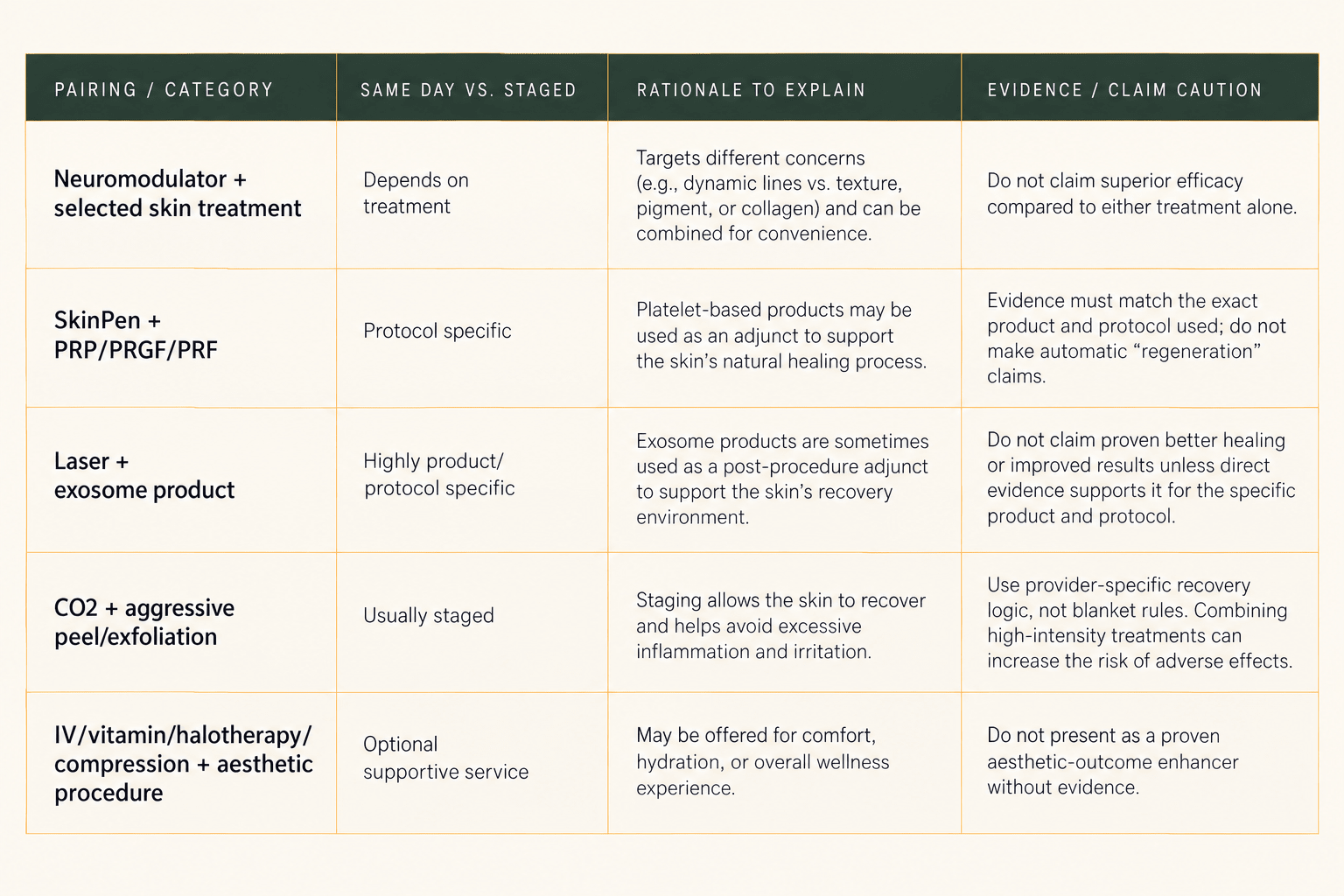
Neuromodulator injections, for example, may sometimes be performed during the same appointment as noninvasive treatments when the provider determines the combination and sequence appropriate. Certain facial or LED therapies may also fit into a same-day plan. However, including them shouldn’t imply that they enhance the results of an injectable or other aesthetic procedure unless evidence supports that specific benefit. Providers must consider what happens to the skin during each step. A procedure that generates heat, causes inflammation or controlled wounds, or disrupts the skin barrier affects whether another treatment should follow. Similarly, injection sites and treated anatomy can influence when cleansing, manipulation, massage, or another device-based treatment can safely occur.
The goal of same-day treatment stacking isn’t to fit as much as possible into one appointment. Each pairing—and its order—should have a clear rationale based on safety, timing, recovery, different treatment targets, or patient convenience.
Which Treatments Are Better Staged?
High-intensity resurfacing procedures, aggressive chemical peels, treatments that create inflammation, and some energy-based procedures may be better separated. Staging treatments allows the skin barrier and underlying tissues to heal, inflammation to resolve, and the provider to evaluate the response before adding another treatment. Spacing procedures isn't a failure to “stack”—it can be an important part of an optimized combination plan.
The more intense the procedure, the more important the recovery period. Ablative laser resurfacing, for example, creates controlled tissue injuries to initiate a healing response. Aggressive chemical peels also significantly affect the epidermis and, depending on peel depth, deeper layers of skin. Adding another inflammatory or energy-based procedure before sufficient healing occurs may increase the risk of adverse effects and lacks evidence that doing more at once produces a better result.
Repeated energy treatments may also be spaced. Rather than layering multiple interventions into one appointment, a provider may address one concern, allow the tissue to recover, assess the outcome, and then move on to another issue. That sequencing can also make it easier to determine how the patient responds to each procedure.
What About Microneedling With PRP/PRGF/PRF or Exosome Products?
Microneedling is sometimes combined in the same visit with platelet-based treatments such as PRP, PRGF, or PRF, as well as products containing exosomes. However, these add-ons are not interchangeable or assumed to improve results. Microneedling creates controlled micro-injuries while platelet-derived preparations contain growth factors involved in tissue repair. However, since there is no standardized preparation, protocol, indication, or method of application, the evidence of these procedures, as well as their results, varies. Exosome products require even more caution. A 2026 systematic review of microneedling with exosomes found only eight studies suitable for its final analysis and concluded that more research is needed to establish both efficacy and long-term safety. Currently, no exosome products are FDA-approved.
Do IV Therapy, Vitamin Shots, Halotherapy, or Compression Improve Aesthetic Results?
IV therapy, vitamin injections, halotherapy, and compression may be offered alongside aesthetic treatments, but there is limited evidence that these options improve the results of lasers, injectables, or skin resurfacing. Dr. Kennedy elaborates, “Not every wellness add-on needs to serve a clinical purpose or enhance aesthetic results. Some services are simply designed to help patients feel more relaxed, comfortable, or refreshed during their visit, and there’s value in that experience. The important distinction is being transparent about what an add-on can realistically deliver. If there’s no clear evidence that it improves treatment outcomes, it should be presented as an optional part of the experience rather than a necessary step in achieving better results.” Their value is better framed around overall wellness, comfort, hydration, and recovery support rather than as medically necessary steps for “optimizing” an aesthetic result. Any claim that an add-on improves healing or efficacy should be supported by evidence for that exact combination.
Evidence associated with IV vitamin therapy is particularly limited in patients without a documented deficiency or medical indication. A 2023 evidence review found a lack of data proving that high-dose vitamin infusions provide health benefits in otherwise healthy individuals. A lack of strong evidence does not support the broader claim that an IV drip given around an aesthetic procedure will improve skin healing or enhance the procedure’s cosmetic result.
The same theory applies to vitamin and peptide injections. Correcting a diagnosed nutritional deficiency can be medically appropriate, but that is different from adding an injection to a laser or injectable appointment in the expectation that it will produce better results or a faster recovery. Evidence supporting that type of routine aesthetic pairing is limited.
Halotherapy, which generally involves exposure to dry salt aerosol, is another optional wellness service rather than an established aesthetic adjunct. There is not strong clinical evidence showing that halotherapy improves the results or healing of commonly performed cosmetic procedures.
Compression has clearer medical applications, particularly for managing edema in specific clinical settings, but that evidence should not be generalized to every aesthetic treatment. Compression can affect edema and tissue mechanics in certain medical conditions, while earlier research on controlled cold compression after facial surgery suggested possible reductions in postoperative swelling and pain. Those findings, however, do not show that routine compression improves the result of nonsurgical treatments such as injectables or lasers.
What should patients ask before agreeing to a combination plan?
Before agreeing to a combination treatment plan, patients should understand why each procedure is being recommended and what results to expect. Ask whether the treatments address different concerns, whether there is evidence that combining them improves the outcome, and whether they should be performed during the same appointment or staged over time. Just as important, find out whether adding another treatment changes the risks, downtime, recovery, or total cost.
A few questions patients can ask their provider for a better understanding of a combination plan include:
- What does each treatment accomplish that the other doesn't?
- What evidence supports using these treatments together?
- Would separating them change the expected outcome?
- Does performing them together introduce additional side effects or make recovery more difficult?
For wellness or comfort add-ons, ask whether they are necessary to include and how the treatment will change if you omit them. If an IV infusion, vitamin injection, compression treatment, LED session, or other service is described as improving healing or enhancing results, always ask to see the evidence that supports that claim.
Finally, make sure to discuss with your provider the incremental cost of each therapy, rather than focusing only on the package price. Patients should understand what is essential to the treatment plan, what is optional, and what benefit each expense is expected to provide. A good combination plan should be easy to explain. Every treatment should have a defined purpose—and patients should understand what they gain, what additional risk or downtime they take on, and what they can reasonably expect if they choose to leave an add-on out.
Discover science-backed solutions from AEDIT Medshop
We’ve taken out the guesswork so you can shop with confidence, knowing you’re choosing what’s right for you.