How Much Does An Eyebrow Transplant Cost?
If you’re thinking about filling out your brows, there are a myriad of cosmetic surgery options. If you have questions about the different techniques and costs associated with them, we’re here to help!
Written By: Erin Storm, PA-C
Published: September 14, 2021
Last updated: December 22, 2021
For everyday skincare essentials, pre- and post-treatment support, procedure enhancers, or even treatment alternatives, we’ve got you covered.

The Skinny
Content Reviewed by AEDIT Medical Advisory Board
What is the average cost of an eyebrow transplant?
The average cost of an eyebrow transplant procedure is between $3,000 to $6,000, but there are other possible expenses (more on them below!) that should be considered when booking a procedure. Candidates considering a surgical eyebrow transplant will find it helpful to understand the factors that contribute to the overall price of a cosmetic procedure.

- Average Cost of an Eyebrow Transplant: $4,500
- Price Range for Eyebrow Transplant: $3,000 - $8,000
The table below offers an outline of potential elements that will contribute to the final cost.
Factors to Consider in the Total Cost of an Eyebrow Transplant
| Cost Factor | Explanation | | ---------- | ---------- | | Type of Transplant | Follicular Unit Extraction (FUE) and Follicular Unit Transplantation (FUT) | | Provider | Training, experience, specialty (dermatology vs. plastic surgery provider) | | Consultation Fees | May or may not count towards the final cost of the procedure | | Anesthesiologist Fees | May not be applicable | | Location | Provider fees vary by region | | Recovery Expenses | Special equipment, follows ups, etc. |
The Specifics
What are the types of eyebrow transplant techniques?
If you’re ready to fill out those brows, then it’s time to figure out what types of eyebrow transplant procedures are available. Regardless of if your hair loss is from a medical condition like alopecia or over-plucking, eyebrow hair transplants can be broken down into two main categories: Follicular Unit Extraction (FUE) and Follicular Unit Transplantation (FUT).
These procedures mostly vary by technique. Both FUT and FUE take hair grafts from a donor site or donor area and transplant them into the brow area for a permanent solution with natural hair growth for eyebrow restoration. Follicular Unit Transplantation (FUT) can leave a visible scar since it takes a strip of donor hair from the back of the head, so it isn’t recommended for those with short hair. It also has more side effects and longer downtime. Follicular Unit Extraction (FUE) is thought to leave less noticeable scarring, but is a longer procedure with more risk of suboptimal results.
From a cost perspective, FUT and FUE hair transplantation are typically similar in cost, though FUE may be slightly more expensive in some instances. In general, hair transplants and hair restoration are priced on a price per follicle basis. More follicles harvested means more transplanted hair and higher overall cost. The average cost of a follicle is difficult to average across the country, which is why we will mostly report cost based on the entire procedure rather than per hair follicle.
What affects the cost of an eyebrow transplant?
It’s time to consider more specifically the variables we introduced in the first table. As a reminder, the information here is an estimate. Consultations with providers will always make for the most accurate assessment of the cost of your eyebrow transplant.
That being said, the following information can help you get an idea of the questions to ask and factors to consider when going into a consultation so you can feel empowered and informed throughout your cosmetic experience.
- Procedure Type: FUT and FUE are similar in cost, but generally FUT is slightly less expensive than FUE.
- Provider: A more experienced, board certified plastic surgeon or specialized provider usually charges more for their expertise, which may lead to higher consultation fees (that may or may not be applied as a credit towards the cost of the actual procedure) and a higher procedure cost.
- Anesthesiologist: This is typically not a component of an eyebrow transplant, but, so you know, general anesthesia requires more expertise and is more expensive than local anesthesia. Local anesthetics generally do not need to be administered by an anesthesiologist.
- Location: The 2018 American Society of Plastic Surgeons (ASPS) Report breaks procedures down by regions. The east and west coasts accounted for 44 percent of all hair transplants performed in 2018. The center of the country accounted for the remaining 56 percent. Given the consistent distribution across the country, costs may not vary as considerably based on location in contrast to other cosmetic procedures where the coasts are significantly more expensive.
- Recovery: Eyebrow transplant recovery will vary by procedure type, Recovery may include prescriptions, recovery garments, follow ups, and time off from work.
The most appropriate eyebrow transplant technique for a candidate will be dependent on their unique needs. The table below provides additional details specific to each transplant type.
Types of Eyebrow Transplants and the Effect on Cost
| Type | Impact on Cost | | ---------- | ---------- | | Follicular Unit Extraction (FUE) | Less precise technique with large donor scalp area; possibly less costly. | | Follicular Unit Transplantation (FUT) | More precise technique that takes more time and may be more expensive. |
What does the cost of an eyebrow transplant include?
We’ve covered the basics and overviewed the different types of eyebrow transplants. Are you still wondering what the price of an eyebrow transplant truly includes? Let’s dive deeper.
The cost of the time the surgeon spends performing the eyebrow transplant procedure is most often what gets quoted as the ‘average cost’ or ‘surgeon’s fee.’ This is not an exact comparison, but it’s basically the hourly rate of your provider. Your provider has their own business expenses like office rent, payroll for support staff, professional insurance, and office/medical supplies. This is all in addition to their personal salary.
Eyebrow transplant costs start to rise as additional factors are added. The other medical staff in the room during your procedure (possibly an anesthesiologist, nurses, or surgical assistants), the various tools and supplies used during your eyebrow transplant (needles, gauze, gowns, gloves, etc.), medications before, during, and after your transplant (may include sedatives, painkillers, and/or antibiotics), and the charge for using the facility’s operating or procedure room.
Another thing to keep in mind is the personal expenses you will encounter as you go about your eyebrow transplant cosmetic experience. These may include consultation fees with providers, your travel costs, pre-operative care, missed work time, and recovery supplies you personally purchase.
How much does an eyebrow transplant cost?
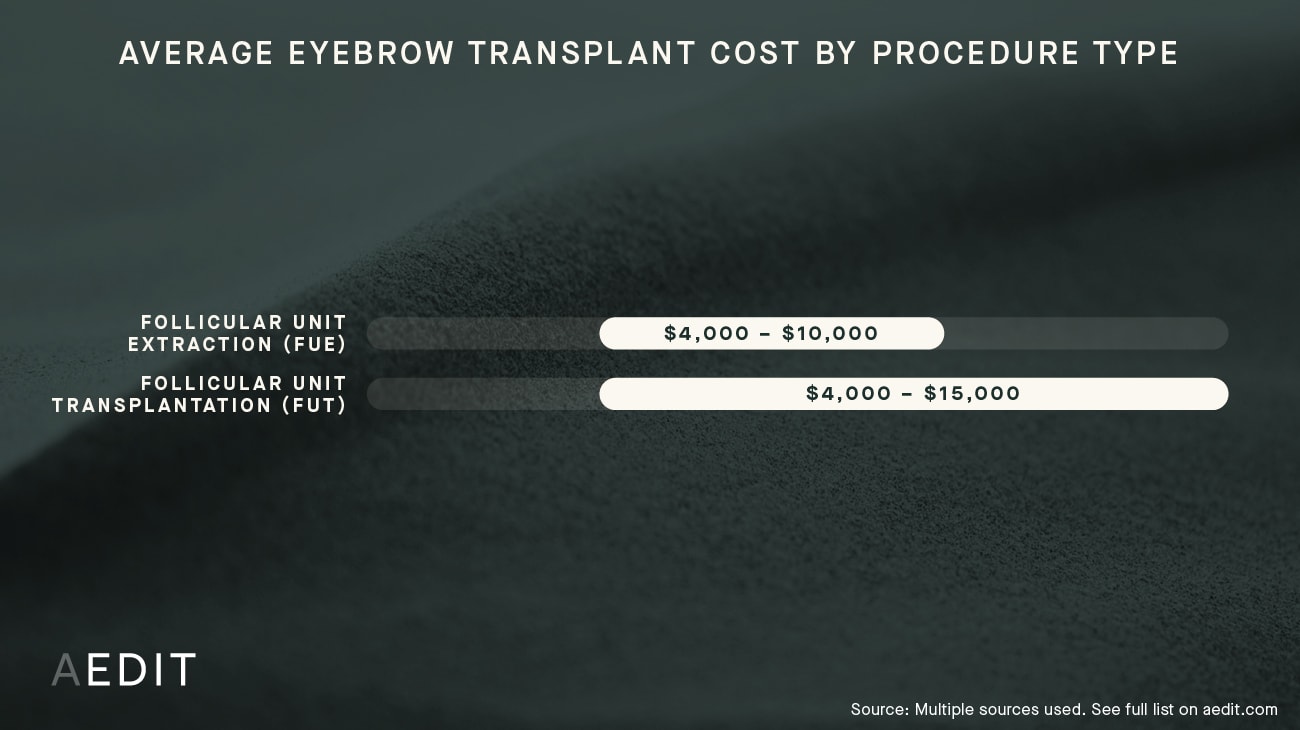
Next question: What kind of numbers are we actually talking about? This table shows cost range estimates by specific eyebrow transplant procedure type. These procedures include all of the variables we discussed without your personal expenses factored in. The ranges are, well,wide-ranging, but they can help give you an idea of which eyebrow transplant types are more costly in general.
Average Eyebrow Transplant Cost by Procedure Type
| Type | Average Cost | | ---------- | ---------- | | Follicular Unit Extraction (FUE) | $4,000 to $10,000 | | Follicular Unit Transplantation (FUT) | $4,000 to $15,000 |
How much does an eyebrow transplant cost across the United States?
It’s all about location, location, location! In case we haven’t made it clear, location plays a large role in the overall cost of a cosmetic procedure. As we mentioned, the 2018 ASPS Report breaks procedures down by regions. In 2018, the coasts accounted for 44 percent of all hair transplants and the center of the country accounted for the remaining 56 percent.
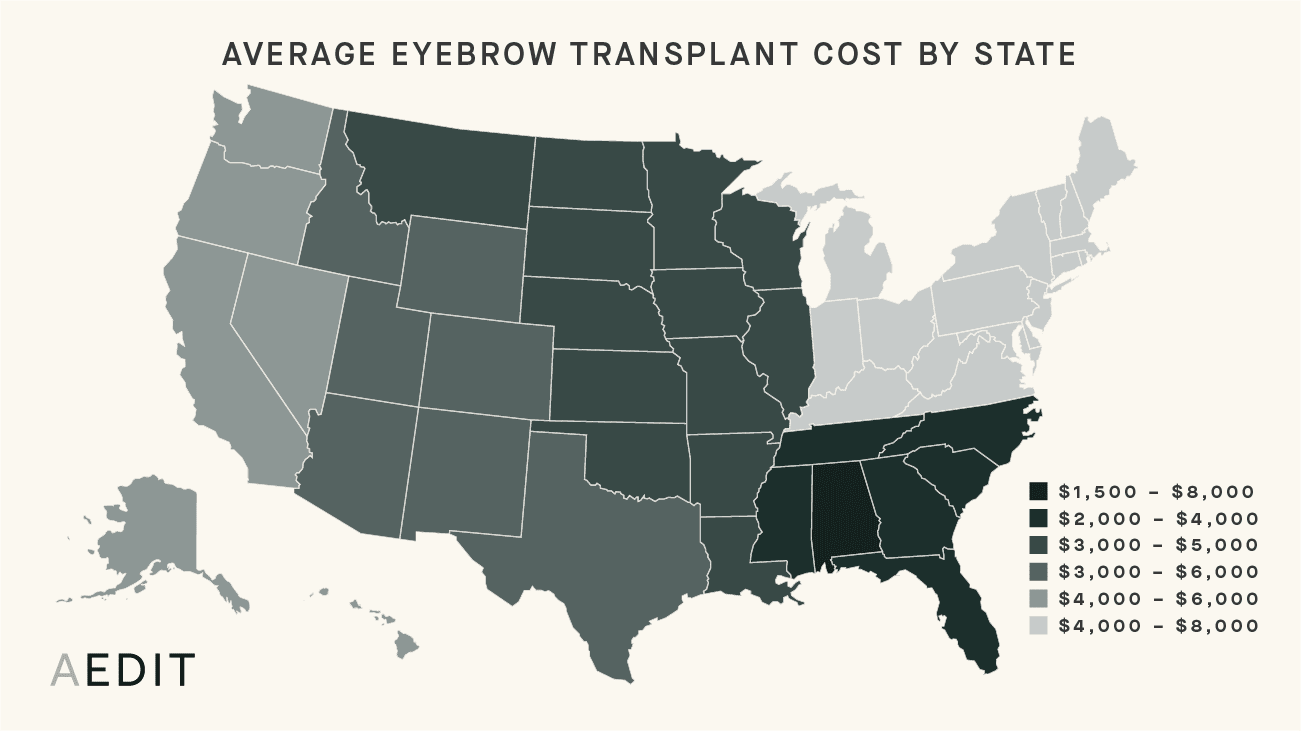
The table below breaks down costs in major cities across the US.
Average Eyebrow Transplant Cost by City and State
| State | Average Cost | | ---------- | ---------- | | New York, NY | $4,000 to $8,000 | | Chicago, IL | $3,000 to $5,000 | | Miami, FL | $2,000 to $4,000 | | Birmingham, AL | $1,500 to $8,000 | | Austin, TX | $3,000 to $6,000 | | Los Angeles, CA | $4,000 to $6,000 |
How much does an eyebrow transplant cost around the world?
For those considering pursuing cosmetic surgery procedures like an eyebrow transplant abroad, the following table compares average cost ranges around the globe. Friendly reminder to factor in travel expenses, consider the reputation of the provider and facility, and add in the additional costs related to recovery times when taking into account the listed prices. The table below reflects costs converted to U.S. dollars.
Average Eyebrow Transplant Cost by Country in USD
| Country | Average Cost | | ---------- | ---------- | | Canada | $3,000 to $6,000 | | Mexico | $1,500 to $4,000 | | Colombia | $1,200 to $3,500 | | United Kingdom | $3,500 to $7,000 | | Australia | $3,500 to $6,000 | | Japan | $3,000 to $6,000 | | United Arab Emirates | $2,000 to $5,000 |
Does insurance cover the cost of an eyebrow transplant?
So, does insurance cover a hair transplant? It’s a common question, and the answer is maybe. To help answer this question, let’s review two definitions from the American Medical Association (AMA):
- Cosmetic Surgery: Procedures for reshaping normal structures for improved appearance and self-esteem.
- Reconstructive Surgery: Procedures performed on abnormal body structures resulting from congenital defects, developmental abnormalities, trauma, disease, infection, or tumors.
Let’s summarize: Cosmetic procedures are not covered by insurance. Reconstructive surgeries may be. In the case of an eyebrow transplant, there is hardly ever a functional indication for performing the procedure. So, since it’s cosmetic, insurance is not going to assist with or cover costs.
We will say that some individuals may be pursuing an eyebrow transplant following eyebrow hair loss secondary to a medical condition or medication. Some cosmetic procedures are covered if the patient’s medical provider can document medical necessity and evidence that alternative therapies have been tried and failed. The ASPS has more detailed criteria you can review with a provider during consultation.
One more caveat: Hybrid procedures (i.e. ones that are both aesthetic and functional) may not be covered despite the functional benefit. Unless you have a consistently proven and documented medical condition, your eyebrow transplant will not be covered.
The Takeaway
We know the decision to pursue plastic surgery is a big deal. From procedure type to cost to results, there are a lot of factors to consider. An eyebrow transplant is an effective permanent solution for hair loss in the eyebrow area. And, for those thinking about undergoing eyebrow hair restoration, all of this information (we know, it was a lot) has hopefully given you a better idea of what your eyebrow transplant procedure may cost and why.
To learn more about our content creation practices, visit our Editorial Process page.
Source List
- American Society of Plastic Surgeons 2018 Plastic Surgery Statistics Report plasticsurgery.org; 2019-01-01
- American Board of Cosmetic Surgery Cosmetic Surgery Prices www.americanboardcosmeticsurgery.org
- Conrad J Harrison, Michael Tyler, Jeremy Rodrigues Value-based Plastic Surgery pubmed.gov; 2020-12-01
- Natalia Ziolkowski et al. Systematic review of economic evaluations in plastic surgery pubmed.gov; 2013-07-01
- Madeleine Blank, et al. The underreporting of cost perspective in cost-analysis research: A systematic review of the plastic surgery literature pubmed.gov; 2019-03-07

